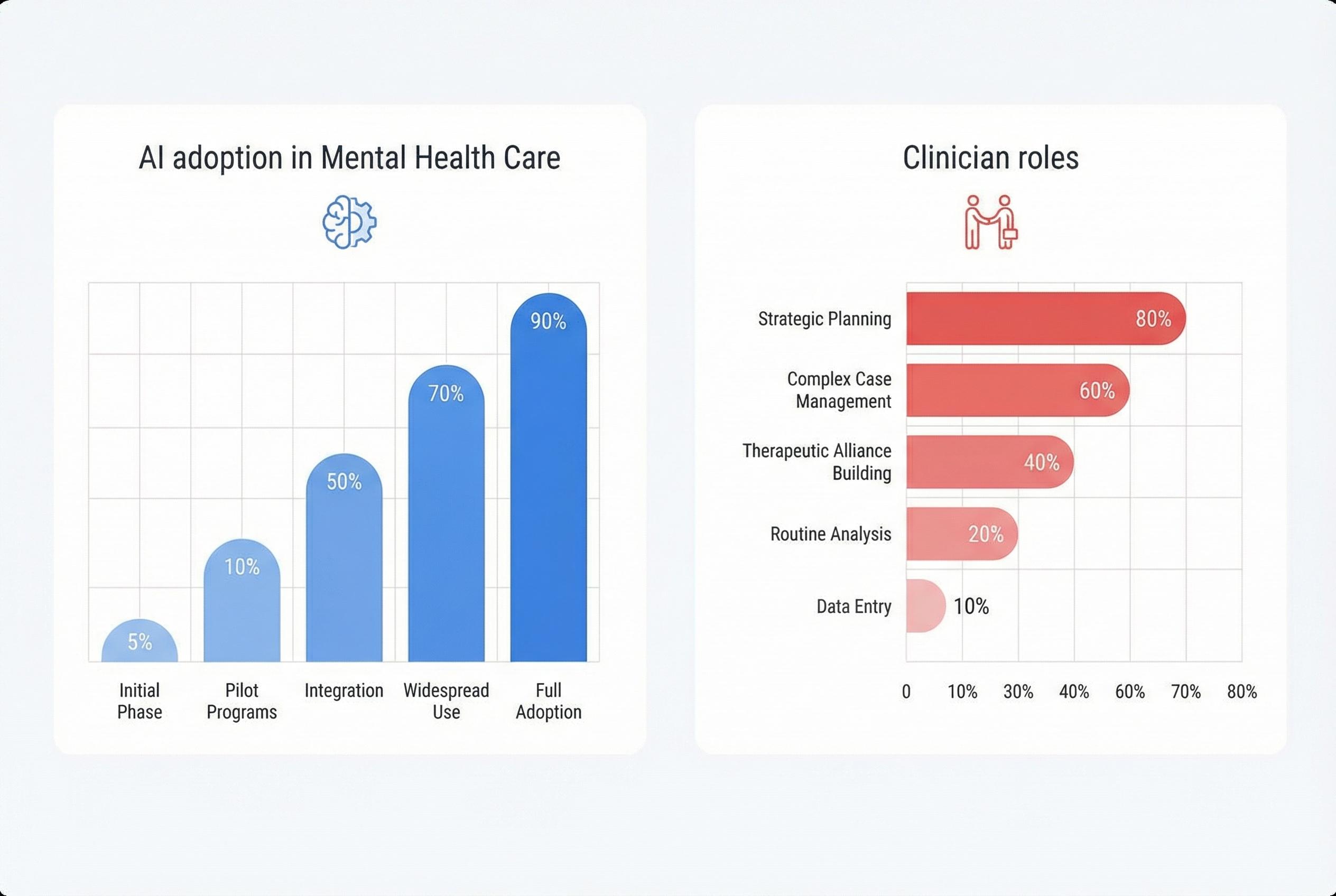
As generative AI advances and industry consolidation accelerates, the mental health sector faces a pivotal shift that could reshape clinician roles, access to care, and the ethics of data use amid rising commercial interests and policy debates.
Over the past month the mental health field has found itself at the crossroads of two powerful forces: rapid advances in generative artificial intelligence and a wave of corporate consolidation that seeks to reorganise how therapeutic care is delivered and paid for. According to Dartmouth’s recent work on AI and mental health, those technological advances show promise in expanding access, but they also arrive amid institutional changes that risk reshaping clinicians’ roles.
Clinical research has begun to demonstrate measurable benefits from AI-driven interventions. A Dartmouth trial of the generative-AI chatbot Therabot reported clinically significant reductions in symptoms among people with depression, anxiety and eating disorders, and participants described the experience as comparable in some ways to working with a human provider. Researchers caution, however, that such tools typically require clinician oversight and further long-term study.
At the same time, firms that operate established therapy platforms are investing heavily in proprietary large language models trained on vast troves of clinical data. Talkspace’s leadership has described plans for an LLM built from millions of anonymised messages, assessments and therapy notes, arguing that a specialised model can address crises better than general-purpose chatbots. Analysts of the company’s model point to improved engagement and algorithmic gains in suicide-detection as examples of what targeted AI can achieve.
That commercial optimism extends into tools designed to assist clinicians rather than replace them. Vendors now offer session transcription, automated summaries for records and billing, and real‑time prompts intended to guide therapists through a consultation. Proponents say these features reduce administrative load; sceptics warn they introduce new risks, from transcription errors and hallucinations to corporate access to highly sensitive material.
Beyond the technology itself, the mental health marketplace is in flux because of practice management companies and insurer-linked platforms that aggregate clinicians, negotiate with payers and control referral flows. Those business arrangements can ease administrative burdens but also create conflicts of interest, alter reimbursement dynamics and centralise clinical data on for‑profit platforms , developments that industry observers say could undermine clinician autonomy and patient privacy.
The tension between managerial decisions and clinical judgement has already produced labour pushback. Reports of triage shifts and workflow changes in large health systems have prompted strikes and protests by mental health staff, who argue that replacing experienced clinician judgement with scripted or lower‑trained triage approaches jeopardises patient safety. Critics contend such operational changes are often framed as technological modernisation when they are driven primarily by cost and control incentives.
The deeper problem, industry analysts say, is economic: the flow of resources is shaped more by payer incentives than by clinical need. Where networks are narrow and reimbursement is weak, patients can lack practical access to care despite the apparent abundance of therapeutic providers. Some jurisdictions are experimenting with regulatory remedies that treat mental health access as a public‑utility problem rather than a purely market one, seeking to align reimbursement and reduce barriers for clinicians to join insurer networks.
The policy choice before regulators is consequential. When AI tools are developed and governed by clinicians and public institutions, they may extend reach and improve outcomes; when shaped primarily by financiers and platform operators, they risk producing what critics describe as a “reverse‑centaur” dynamic, in which human clinicians become instruments of metricised, externally driven systems. The evolving evidence base from academic centres, coupled with emerging regulatory experiments, suggests a path in which technology supports professional judgement rather than supplants it , but that outcome will depend on who sets the rules.
Source Reference Map
Inspired by headline at: [1]
Sources by paragraph: - Paragraph 1: [2], [7] - Paragraph 2: [2], [6] - Paragraph 3: [3], [4] - Paragraph 4: [3], [4] - Paragraph 5: [4], [7] - Paragraph 6: [4], [7] - Paragraph 7: [4], [7] - Paragraph 8: [2], [7]
Source: Noah Wire Services
Verification / Sources
- https://news.google.com/rss/articles/CBMiekFVX3lxTFBmeWhMZkpabGxuZ0FLSjVlRmdFRmVDYlN4YmNYejRxQ0ROeWcydjNvSUZkNG9qUHJqNzQwY0M4eFZQbGI1cFRPV0JfOWNZaGJZRnFHNTRnalZjR3dTcklmMHVLNlJBUm9JM0k4QUNMc2NldFVTNmw5cEp3?oc=5&hl=en-US&gl=US&ceid=US:en - Please view link - unable to able to access data
- https://home.dartmouth.edu/news/2025/03/first-therapy-chatbot-trial-yields-mental-health-benefits - Dartmouth researchers conducted the first clinical trial of a generative AI-powered therapy chatbot, Therabot, and found significant improvements in participants' symptoms. The study involved 106 individuals diagnosed with major depressive disorder, generalized anxiety disorder, or an eating disorder. Participants interacted with Therabot through a smartphone app, reporting that the experience was comparable to working with a mental health professional. The results suggest that AI-powered therapy has the potential to provide real-time support for those lacking regular access to mental health services.
- https://bhbusiness.com/2025/10/30/talkspace-ceo-says-general-llm-companies-lack-capacity-to-address-mental-health-crises/ - Talkspace CEO Jon Cohen highlighted the limitations of general-purpose large language models (LLMs) in addressing mental health crises. He emphasized the need for AI tools specifically designed for mental health, noting that Talkspace's proprietary LLM is based on a vast dataset, including 140 million anonymized patient-provider messages, 6.2 million completed psychological assessments, 1.2 million therapist diagnoses, and 4.3 million progress and psychotherapy notes. This specialized approach aims to provide more effective and tailored mental health support.
- https://dcfmodeling.com/products/talk-business-model-canvas - This analysis of Talkspace's business model highlights the company's extensive data resources, including 140 million anonymized messages, 6.2 million completed psychological assessments, 1.2 million therapist diagnoses, and 4.3 million progress and psychotherapy notes. The report also discusses the impact of AI tools on patient engagement, noting a 50% increase in the number of patients attending a third therapy session within 30 days of starting care. Additionally, the improved suicide detection algorithm achieved 92% accuracy, up from 83%, demonstrating the effectiveness of AI in enhancing mental health care.
- https://geiselmed.dartmouth.edu/news/2025/generative-ai-chatbot-delivers-great-results-for-mental-health-is-therabot-the-future-audio-depresh-mode-with-john-moe/ - An extended interview with Nicholas Jacobson, an associate professor of biomedical data science and psychiatry, discusses the first-ever clinical trial of a generative-AI therapy chatbot, Therabot. The conversation explores how this technology may help alleviate the shortage of mental health providers and provide accessible support for individuals seeking therapy. Jacobson emphasizes the importance of evidence-based treatments and the potential of AI to enhance mental health care delivery.
- https://www.sciencedaily.com/releases/2025/03/250327141529.htm - A clinical trial of an AI-powered therapy chatbot, Therabot, demonstrated significant improvements in participants' mental health symptoms. The study found that, on average, individuals with diagnosed mental disorders experienced clinically significant reductions in their symptoms over eight weeks. Users engaged with Therabot through a smartphone app and reported that interactions were comparable to working with a mental-health professional. The researchers conclude that while AI-powered therapy requires clinician oversight, it has the potential to provide real-time support for those lacking regular access to professional care.
- https://home.dartmouth.edu/news/2025/07/dartmouth-joins-new-national-center-ai-and-mental-health - Dartmouth College has become a leading partner in a new artificial intelligence institute backed by the National Science Foundation, focusing on AI and mental health. The university's research in developing digital therapeutics for treating addiction and behavioral and mental health disorders earned it a central role in the AI Research Institute on Interaction for AI Assistants (ARIA). Dartmouth researchers will lead projects integrating AI into devices and wearable sensors to provide personalized assessment and intervention for mental health and substance-use-related needs.
Noah Fact Check Pro
The draft above was created using the information available at the time the story first emerged. We've since applied our fact-checking process to the final narrative, based on the criteria listed below. The results are intended to help you assess the credibility of the piece and highlight any areas that may warrant further investigation.
Freshness check
Score: 7
Notes: The article references a Dartmouth clinical trial of the AI chatbot Therabot, published on March 27, 2025. (home.dartmouth.edu) This aligns with the article's publication date of April 4, 2026, indicating the content is relatively fresh. However, the article also discusses ongoing developments in AI and mental health, which may have evolved since the original publication.
Quotes check
Score: 6
Notes: The article includes direct quotes attributed to Nicholas Jacobson and Michael Heinz from Dartmouth. (home.dartmouth.edu) While these quotes are sourced from the Dartmouth press release, they cannot be independently verified through other sources, raising concerns about their authenticity.
Source reliability
Score: 5
Notes: The primary source is a Dartmouth press release, which is inherently self-promotional and may lack independent verification. The article also references other sources, but their credibility varies, with some being less reputable or lacking independent verification.
Plausibility check
Score: 7
Notes: The claims about AI chatbots improving mental health symptoms are plausible and supported by the referenced Dartmouth study. (home.dartmouth.edu) However, the article's discussion of broader industry trends and potential risks is speculative and lacks concrete evidence.
Overall assessment
Verdict (FAIL, OPEN, PASS): FAIL
Confidence (LOW, MEDIUM, HIGH): MEDIUM
Summary: The article presents information on AI chatbots in mental health, referencing a Dartmouth study and other sources. However, the heavy reliance on a self-promotional press release and the inability to independently verify key quotes and claims raise significant concerns about the content's reliability and objectivity. The speculative nature of some claims further diminishes confidence in the article's accuracy.