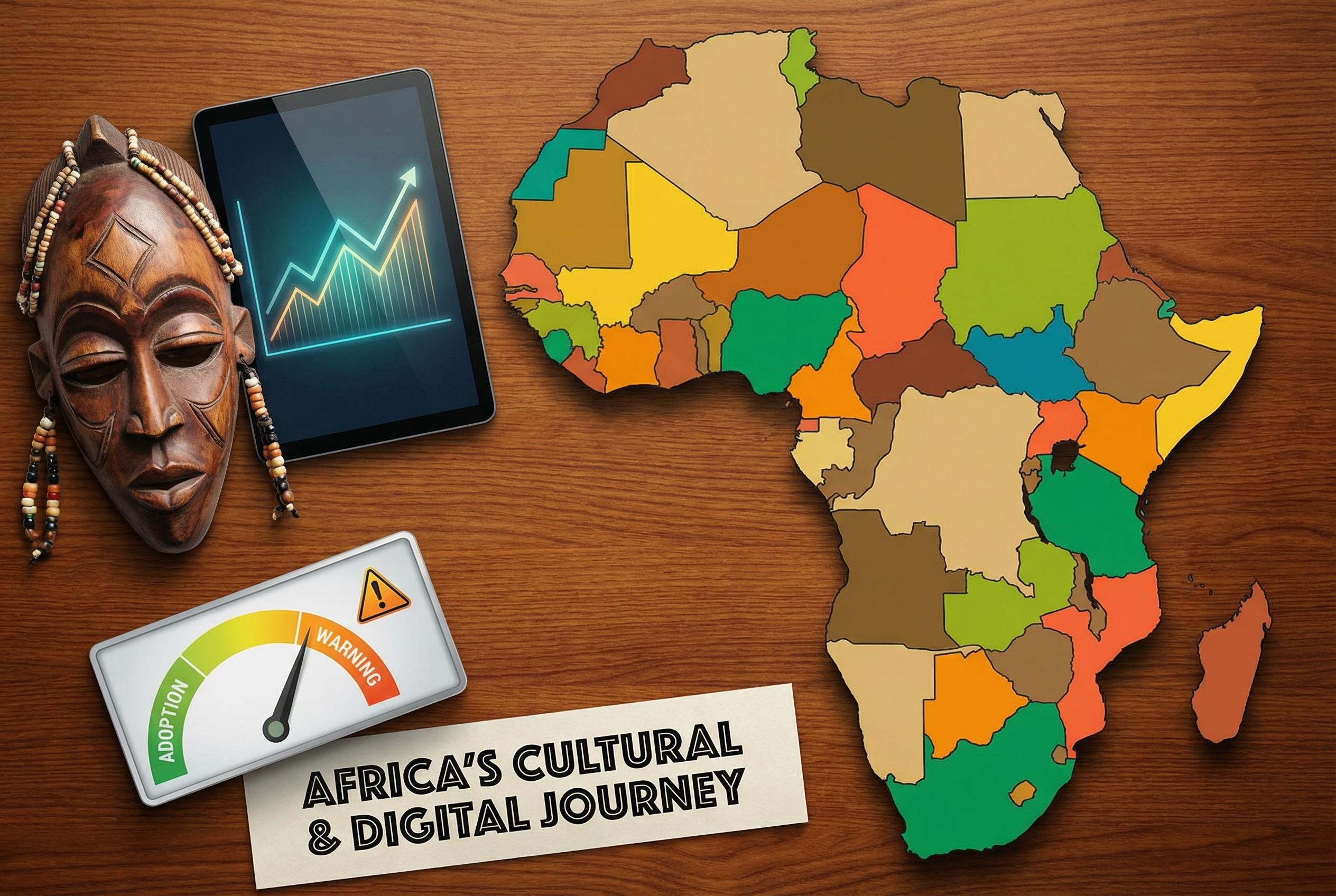
As AI advances threaten the authenticity and equitable stewardship of African cultural expressions, experts urge urgent reforms to ensure participatory, culturally sensitive governance and safeguard communal rights in the digital age.
Artificial intelligence has forced a reappraisal of how African cultural expression is valued and protected,shifting the focus from singular works to the underlying patterns that enable creativity to be reproduced at scale.According to UNESCO, AI can be a tool for preserving intangible cultural heritage while simultaneously risking its authenticity and equitable stewardship.Industry scholars warn that generative systems trained on online material may appropriate musical forms and ritual practices without recognising or compensating source communities.
The problem is not only technical but epistemic.A UNESCO analysis of AI in African education systems highlights how models often embed the worldviews of their creators,rather than indigenous knowledge,so outputs can misrepresent or dilute local meanings when deployed in classrooms or cultural platforms.This misalignment deepens when datasets lack provenance and communities are excluded from design decisions.
Historically, disruptive technologies have exposed gaps in legal and institutional frameworks.Napster-era debates over distribution and value are echoed today in disputes about dataset construction and model ownership;South African legal commentators argue current copyright statutes struggle to address AI’s capacity to generate content autonomously,leaving creators legally unprotected and rights unclear. Libraries and archives, meanwhile, face ethical dilemmas when digitising material that may later feed commercial AI systems.
On the ground the consequences are tangible.Musicologists and legal analysts caution that generative tools can reproduce stylistic signatures of indigenous repertoires,transforming vocal timbres, rhythms and lyric patterns into commodified outputs without cultural context or consent.Such replication risks severing creative forms from their communal histories and spiritual significances,undermining the social mechanisms that sustain them.
That legal inadequacy has economic consequences.When cultural labour embedded in training data goes unacknowledged,value accrues to platform owners and model developers rather than performers,traditional custodians or local industries.Evaluations of regional copyright regimes conclude that piecemeal updates will be insufficient;comprehensive reform is needed to address authorship,derivative works,and dataset-use rights in ways that reflect communal as well as individual claims.
Responding requires both technical and institutional innovation.Unesco calls for responsible AI approaches that respect cultural diversity and ensure equitable access,urging participatory design,transparent disclosure of training sources and tools that allow communities to retain agency over how their cultural expressions are represented.Governance mechanisms must be built around consent,benefit-sharing and culturally sensitive provenance standards.
Practical measures are emerging from research and heritage institutions:libraries and archives can act as custodians of verified digitised collections with controlled access;ethnomusicologists can collaborate on metadata standards that capture lineage and ritual meaning;and legal frameworks can incorporate mandatory dataset disclosure,licensing regimes tailored to communal rights,and remuneration models for cultural contributors.Collectively these steps can rebalance power in favour of origin communities.
If African cultural agency is to survive and flourish in the AI era,it will depend on fast,coordinated action by policymakers,heritage institutions,scholars and technologists to enshrine consent,compensation and provenance into law and practice.Unesco’s guidance underscores that,if designed inclusively,AI can support transmission and revitalisation of traditions;but without governance that foregrounds local values,technology will replicate existing inequalities rather than remedy them.
Source Reference Map
Inspired by headline at: [1]
Sources by paragraph: - Paragraph 1: [2], [4] - Paragraph 2: [3] - Paragraph 3: [5], [7] - Paragraph 4: [4], [6] - Paragraph 5: [5], [6] - Paragraph 6: [2], [3] - Paragraph 7: [7], [4] - Paragraph 8: [3], [2]
Source: Noah Wire Services
Verification / Sources
- https://afrocritik.com/who-owns-african-culture-in-the-age-of-ai/ - Please view link - unable to able to access data
- https://ich.unesco.org/en/news/exploring-the-impact-of-artificial-intelligence-and-intangible-cultural-heritage-13536 - This UNESCO article discusses the impact of Artificial Intelligence (AI) on intangible cultural heritage, highlighting how AI can both aid in preserving and transmitting cultural practices and pose challenges to their authenticity and ownership. It emphasizes the need for responsible AI development that respects cultural diversity and promotes equitable access to cultural heritage. (ich.unesco.org)
- https://www.unesco.org/en/articles/cultural-cost-ai-africas-education-systems - This UNESCO article examines the cultural implications of AI in African education systems, noting that AI tools often reflect the values and biases of their creators, which may not align with indigenous African worldviews. It advocates for the development of AI educational tools that incorporate indigenous knowledge systems to preserve cultural identity and ensure equity. (unesco.org)
- https://journal.strathmore.edu/index.php/jipit/article/view/502 - This academic paper explores the risks of cultural appropriation posed by generative AI systems to indigenous African musical works. It argues that AI's ability to autonomously generate content based on existing cultural expressions can erode the data and proprietary rights of indigenous communities, undermining their ability to derive value from their intellectual property and sustain their cultural identity. (journal.strathmore.edu)
- https://recordoflaw.in/impact-of-artificial-intelligence-ai-on-south-african-copyright-law-exploring-how-ai-generated-content-challenges-existing-copyright-frameworks/ - This article examines how AI-generated content challenges existing copyright frameworks in South Africa. It argues that the current Copyright Act is incompatible with AI-driven creative processes, leaving content creators without legal protection for their AI-assisted works and creating significant legal dilemmas. (recordoflaw.in)
- https://mail.lawgratis.com/blog-detail/copyright-implications-for-ai-assisted-ethnomusicology-and-cultural-heritage-preservation - This article discusses the copyright implications of AI-assisted ethnomusicology and cultural heritage preservation. It addresses core issues such as authorship and ownership, the public domain versus traditional cultural expressions, and the challenges of fixation and originality in AI-generated works. (mail.lawgratis.com)
- https://repository.ifla.org/handle/20.500.14598/6857 - This study examines the role of libraries, copyright law, and AI in preserving African musical heritage. It explores how libraries and archives can serve as custodians of musical heritage amidst legal and ethical limitations when digitizing and sharing culturally significant works, and discusses the risks of AI-driven cultural appropriation and misuse. (repository.ifla.org)
Noah Fact Check Pro
The draft above was created using the information available at the time the story first emerged. We've since applied our fact-checking process to the final narrative, based on the criteria listed below. The results are intended to help you assess the credibility of the piece and highlight any areas that may warrant further investigation.
Freshness check
Score: 8
Notes: The article was published on April 1, 2026, making it current. However, the topic has been discussed in various contexts, such as AI's impact on African culture and intellectual property, indicating that similar narratives have appeared before. (techcabal.com)
Quotes check
Score: 7
Notes: The article includes direct quotes from UNESCO and other sources. While these quotes are cited, the earliest known usage of these specific quotes could not be independently verified, raising concerns about their originality.
Source reliability
Score: 6
Notes: Afrocritik is a digital media platform focusing on African art, entertainment, and culture. (en.wikipedia.org) While it provides valuable insights, it is a niche publication, which may affect the perceived reliability of its content.
Plausibility check
Score: 8
Notes: The article presents plausible claims regarding AI's impact on African culture and intellectual property. However, the lack of independent verification for some quotes and the reliance on a single source for certain claims reduce the overall credibility.
Overall assessment
Verdict (FAIL, OPEN, PASS): FAIL
Confidence (LOW, MEDIUM, HIGH): MEDIUM
Summary: The article addresses a timely and relevant topic but faces significant issues regarding the originality and verification of its content. The reliance on a single, niche source without sufficient independent verification undermines its overall credibility. Additionally, the inability to independently verify specific quotes further diminishes trustworthiness. Given these concerns, the content cannot be covered under our standard editorial indemnity.