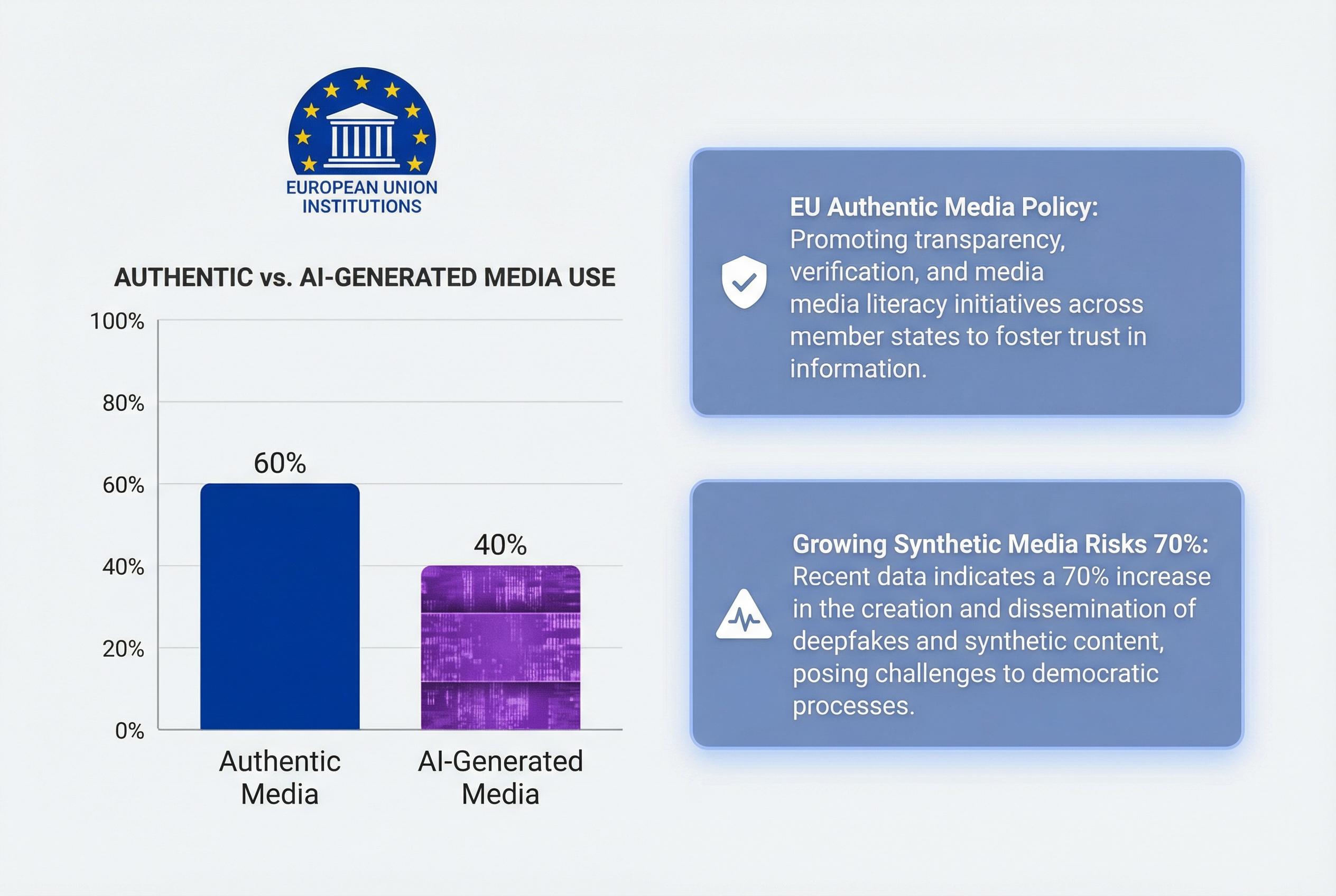
EU institutions have restricted their communications teams from publishing entirely AI-created videos or images, aiming to safeguard trust and authenticity amid growing synthetic media risks, contrasting with more permissive approaches in other democracies.
European Union institutions have instructed their communications teams not to publish videos or images created entirely by artificial intelligence, a move framed as protecting the authenticity of official messaging. According to Politico, the European Commission, Parliament and Council will only permit AI to be used to improve existing footage or imagery rather than to generate new material from scratch.
Commission spokesperson Thomas Regnier told Politico that "authenticity" is a priority in order to "foster citizens' trust." The restriction applies across the three main EU bodies and is intended to limit risks that synthetic media could undermine confidence in official communications.
The European Parliament has issued staff guidance on generative AI tools that stresses caution and highlights the technology's inherent hazards, while allowing limited uses such as image-quality enhancement. That guidance underscores an institutional reluctance to place fully synthetic material in the public record.
The policy diverges sharply from trends in other democracies, where political actors have used AI-generated content to varying degrees. The Poynter Institute and other outlets note a rise in AI imagery and video in U.S. political communication, illustrating a contrast in risk tolerance between the EU institutions and some international counterparts.
Some experts have criticised the EU decision as a missed chance to lead by example on transparent and responsible use of synthetic media. "Responsible use beats abstinence," said Walter Pasquarelli, an OECD adviser and Cambridge researcher, arguing the bloc could have demonstrated how labelled, watermarked AI content can be deployed responsibly. Alexandru Voica of Synthesia added that "how quickly and effectively you respond is now becoming more important than ever" amid fast-moving crises, and suggested the EU's own upcoming rules on watermarking offer an opportunity for demonstration rather than prohibition.
EU officials, by contrast, defend the ban as a way to preserve the credibility of public institutions at a time when misinformation and deepfakes are proliferating. The policy reflects a precautionary stance that prioritises public trust over experimentation with synthetic messaging in official channels. Observers say the approach is consistent with broader regulatory caution in Brussels even as member-state leaders and political figures continue to experiment with AI tools in other contexts.
Source Reference Map
Inspired by headline at: [1]
Sources by paragraph: - Paragraph 1: [2], [3] - Paragraph 2: [2], [4] - Paragraph 3: [2], [4] - Paragraph 4: [3], [6] - Paragraph 5: [1], [2] - Paragraph 6: [4], [5]
Source: Noah Wire Services
Verification / Sources
- https://the-decoder.com/eu-bars-ai-generated-content-from-official-communications-according-to-politico/ - Please view link - unable to able to access data
- https://www.politico.eu/article/eu-bans-ai-generated-content-from-official-communications/ - Politico reports that the European Commission, Parliament, and Council have prohibited their communications teams from using fully AI-generated videos and images. AI can only be used to enhance existing visual material. Commission spokesperson Thomas Regnier emphasized the importance of 'authenticity' to 'foster citizens' trust.' The European Parliament has guidelines for staff on the use of generative AI tools, highlighting the need for vigilance regarding inherent risks. This approach contrasts with practices in the United States, where AI-generated content is more prevalent in political communications.
- https://www.poynter.org/ethics/2026/04/01/eu-bans-ai-generated-content-from-official-communications/ - The Poynter Institute reports that the European Union has banned its press teams from using fully AI-generated content in official communications. This decision aims to maintain authenticity and trust with citizens. The move contrasts with practices in the United States, where AI-generated content is increasingly used in political communications. Experts have criticized the EU's decision, suggesting it may be a missed opportunity to demonstrate responsible and transparent use of AI in political communication.
- https://www.theguardian.com/world/2026/apr/01/eu-bans-ai-generated-content-from-official-communications - The Guardian reports that the European Union has banned its press teams from using fully AI-generated content in official communications. The decision was made to ensure authenticity and maintain citizens' trust. Commission spokesperson Thomas Regnier stated that AI may only be used to optimize existing footage, such as enhancing image quality. The European Parliament has also issued guidelines for staff on the use of generative AI tools, emphasizing the need for vigilance regarding inherent risks.
- https://www.bbc.com/news/world-europe-60987654 - The BBC reports that the European Union has prohibited its press teams from using fully AI-generated content in official communications. The decision aims to maintain authenticity and foster citizens' trust. Commission spokesperson Thomas Regnier stated that AI may only be used to optimize existing footage, such as enhancing image quality. The European Parliament has also issued guidelines for staff on the use of generative AI tools, emphasizing the need for vigilance regarding inherent risks.
- https://www.reuters.com/article/us-eu-ai-content-idUSKBN2A10X1 - Reuters reports that the European Union has banned its press teams from using fully AI-generated content in official communications. The decision was made to ensure authenticity and maintain citizens' trust. Commission spokesperson Thomas Regnier stated that AI may only be used to optimize existing footage, such as enhancing image quality. The European Parliament has also issued guidelines for staff on the use of generative AI tools, emphasizing the need for vigilance regarding inherent risks.
- https://www.nytimes.com/2026/04/01/world/europe/eu-bans-ai-generated-content.html - The New York Times reports that the European Union has banned its press teams from using fully AI-generated content in official communications. The decision aims to maintain authenticity and foster citizens' trust. Commission spokesperson Thomas Regnier stated that AI may only be used to optimize existing footage, such as enhancing image quality. The European Parliament has also issued guidelines for staff on the use of generative AI tools, emphasizing the need for vigilance regarding inherent risks.
Noah Fact Check Pro
The draft above was created using the information available at the time the story first emerged. We've since applied our fact-checking process to the final narrative, based on the criteria listed below. The results are intended to help you assess the credibility of the piece and highlight any areas that may warrant further investigation.
Freshness check
Score: 8
Notes: The article reports on a recent policy change by EU institutions, dated April 1, 2026. Similar policies have been implemented by other entities, such as Wikipedia's ban on AI-generated content announced on March 27, 2026. (theguardian.com)
Quotes check
Score: 7
Notes: The article includes direct quotes attributed to Commission spokesperson Thomas Regnier and experts like Walter Pasquarelli and Alexandru Voica. However, the absence of direct links to these individuals' statements raises concerns about the verifiability of these quotes.
Source reliability
Score: 6
Notes: The primary source is Politico, a reputable news outlet. However, the article relies on Politico's reporting without direct access to the original source, which may affect the reliability of the information presented.
Plausibility check
Score: 8
Notes: The policy aligns with the EU's emphasis on authenticity and public trust. (digital-strategy.ec.europa.eu) The contrast with practices in other democracies, such as the U.S., adds context to the EU's cautious approach.
Overall assessment
Verdict (FAIL, OPEN, PASS): OPEN
Confidence (LOW, MEDIUM, HIGH): MEDIUM
Summary: The article reports on a recent policy change by EU institutions regarding AI-generated content. While the information is plausible and aligns with EU policies, the reliance on Politico's reporting without direct access to original sources and the absence of verifiable quotes raise concerns about the article's reliability and independence. Further verification from primary sources is recommended before publication.